
How to Apply for a Stanislaus County Marriage License
A marriage license comes from the Stanislaus County Clerk-Recorder, not the court. Both people must appear together in person to apply. The office issues the license, and after the ceremony the officiant signs and returns it. The county marriage license page lays out the steps and forms.
The Clerk-Recorder office sits at 1021 I Street, Suite 101 in Modesto, with public hours on weekdays. The Clerk-Recorder marriage license page covers appearance, ID, prior-marriage proof, and the return rule.
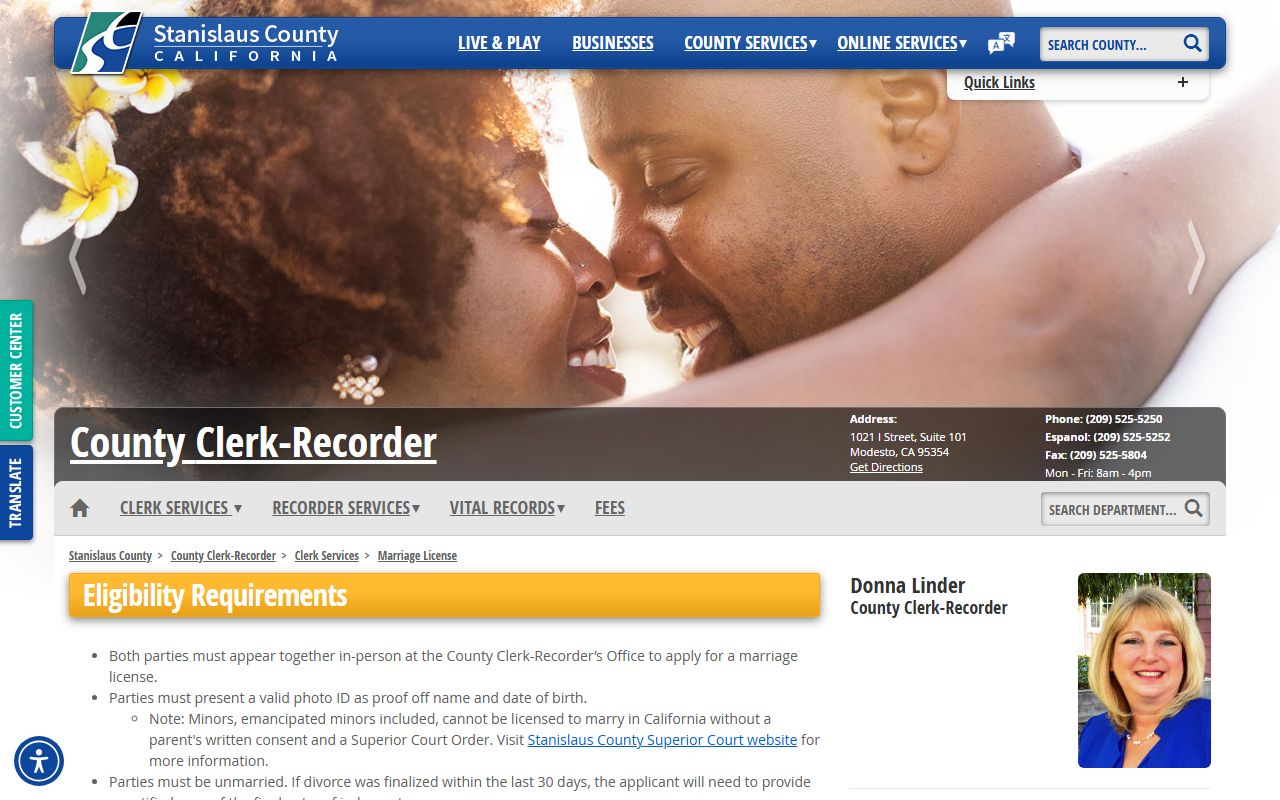
Follow these steps to get a license.
- Both applicants appear together in person at the Clerk-Recorder office.
- Bring valid government ID and proof of age for each person.
- If you were married before, bring divorce papers or a death certificate.
- Choose a public or confidential license and pay the fee.
- Hold the ceremony within 90 days, then have the officiant return the signed license within ten days.
Marriage License Requirements
California sets clear rules for a marriage license. Both parties must appear together and prove who they are. The license has a limited life and a return deadline, so timing matters.
- Both people must be 18 or older to apply without parental consent.
- Both must prove identity and age with valid ID.
- A prior marriage that ended needs divorce papers or a death certificate.
- The license is valid for 90 days in California.
- The ceremony can take place anywhere in the state.
The proof-of-prior-marriage rule catches people off guard. If an earlier marriage ended by divorce or death, bring the paperwork no matter how long ago it happened. The county resident information page is a helpful second reference for people getting married locally.
After the ceremony, the officiant must sign and return the license to the Clerk's office within ten days. Missing that window can delay the official marriage record, so pick an officiant who understands the return rule. Once the signed license is recorded, you can order a certified marriage copy from the Clerk-Recorder whenever you need proof of the marriage.
Marriage License Application Fields
The application asks for identity and history details for both people. Use full legal names that match your ID, since the name on the license carries through to the marriage record. The table lists the main fields and whether each is required.
| Field Label | Type | Required | Notes |
|---|---|---|---|
| Applicant 1 legal name | Text | Yes | Full legal name matching ID. |
| Applicant 2 legal name | Text | Yes | Full legal name matching ID. |
| Date of birth / age | Date | Yes | Must prove age. |
| Current address | Text | Yes | Address for each applicant. |
| Identification | ID | Yes | Government ID required. |
| Previous marriage info | Text / Date | If applies | Divorce or death proof needed. |
| License type choice | Checkbox | Yes | Public or confidential; fee differs. |
| Signatures | Signature | Yes | Both sign in person. |
Because applicants sign in person, plan to visit the office together rather than mailing the form.
Public vs. Confidential Marriage License
California offers two kinds of marriage license, and applicants pick one when they apply. They differ in privacy and in who can later get a copy. The comparison block lays out the key points.
| Public License | Confidential License | |
|---|---|---|
| Record access | A public record at the Clerk-Recorder | Not open to the general public |
| Who can get a copy | Authorized requesters under state law | Generally the spouses or by court order |
| County fee | $76 | $81 |
Pick the type that fits your privacy needs. Both result in a valid marriage, but the confidential license keeps the record out of the public index.
Marriage and Vital Record Fees
The Clerk-Recorder publishes set fees for licenses, ceremonies, and certified copies. The table lists the common amounts.
| Item | Fee |
|---|---|
| Public marriage license | $76 |
| Confidential marriage license | $81 |
| Duplicate marriage license | $11 |
| Civil marriage ceremony | $45 |
| Keepsake certificate | $10 |
| Certified marriage copy | $19 |
Payment is by cash, check, or money order payable to the county Clerk-Recorder. Fees can change, so confirm the current amount before you go. The office does not take third-party checks, and a customer must be present for counter transactions. A keepsake certificate is an optional decorative copy, while a certified marriage copy is the official version you would use for a name change, a benefits claim, or other legal needs.
Searching for Stanislaus County Divorce Records
Divorce is different from marriage. A divorce is a Superior Court family law case, not a Clerk-Recorder vital record. So you search divorce through the court case index, not the county marriage records. The family law division handles divorce, separation, support, custody, and restraining orders.
Family Court Services also supports these cases with mediation and related help. The court's family law division page describes the cases it hears and the services it offers.
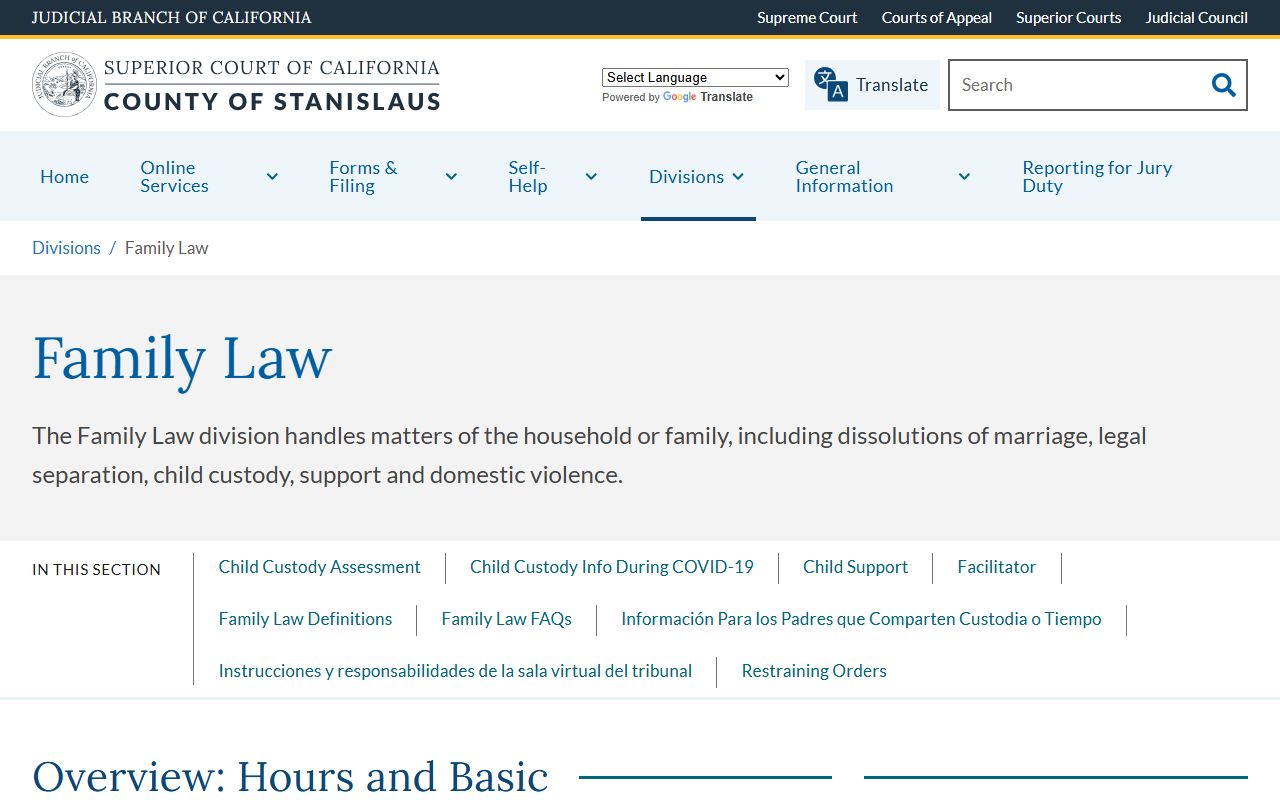
Search the Superior Court case index for public docket data, then contact the family law clerk for copies of documents.
A divorce case docket is generally public, but not every document is. Custody evaluations, minors' details, and confidential mediation papers are held back. So the index may show that a dissolution was filed and resolved, while the sensitive documents behind it stay closed. For a certified copy of a judgment, request it through the court clerk rather than expecting the full file online.
How to File for Divorce in Stanislaus County
California is a no-fault divorce state, so a person can seek dissolution based on irreconcilable differences. The process uses Judicial Council forms and runs through the Superior Court. The Self-Help Center can help a person who does not have a lawyer.
- Use the California Judicial Council forms for dissolution, legal separation, or nullity.
- File in the Superior Court if residency and venue are met.
- Pay the filing fee, or file fee-waiver forms if you cannot afford it.
- Serve the other party and file proof of service and required disclosures.
- Resolve custody, support, property, and debt by agreement or hearing, then submit the judgment.
A divorce is not final until the court enters judgment and the statutory waiting period has run. That waiting period applies even when both spouses agree on everything, so a divorce takes time regardless of how smooth it is. Residency and venue rules also decide whether you can file in Stanislaus County or must file elsewhere, and the Self-Help Center can confirm those rules before you start.
Certified Copies and Self-Help
For a certified marriage copy, go to the Clerk-Recorder. For divorce documents, request copies from the family law clerk at the court. A certified copy carries the official seal and is the version agencies accept. State law sets who may receive a certified vital record and what the fee is, so be ready to show ID and meet the authorized-copy rules when you ask.
Free help is available for self-represented people. The court Self-Help Center assists with divorce, custody, support, and related family matters, and the state forms finder holds the statewide Judicial Council forms. For broader records help, see the County Clerk-Recorder and the Clerk of the Superior Court pages.
Keep the two offices straight as you gather documents. The Clerk-Recorder handles the marriage license and certified marriage, birth, and death copies. The Superior Court clerk handles the divorce case file. Sending a marriage copy request to the court, or a divorce file request to the Clerk-Recorder, only adds delay. Match each request to the office that holds the record.