
Stanislaus County Superior Court Overview
California merged its old municipal and superior courts into a single Superior Court in each county. That change, called trial court unification, is why Stanislaus County has one trial court rather than a layered set of lower courts. A person looking for a county district court should look to the Superior Court instead.
The court splits its work into divisions, but it is still one court. Civil, criminal, family law, juvenile, probate, small claims, and traffic matters all run within it. The court's homepage and division pages are the local map for which division hears what, and where to file.
This single-court design keeps things simpler than it looks. There is one clerk's office, one case index, and one set of public counters for the whole trial court. So whether you are filing a small claims case or following a felony, you start in the same court system. The division mainly decides which judge, department, and rules apply, not which building keeps the file.
California's Court Hierarchy
The Superior Court sits at the trial level, with two appellate levels above it. Stanislaus County belongs to the Fifth Appellate District of the California Courts of Appeal. The table lays out the three levels and what each does.
| Court | Level | Role |
|---|---|---|
| Supreme Court of California | Highest state court | Discretionary review and original writs. |
| Court of Appeal, Fifth Appellate District | Intermediate appeals | Hears appeals from the Stanislaus Superior Court. |
| Superior Court, County of Stanislaus | Trial court | All state trial-level cases for the county. |
So a case starts in the Superior Court and, if appealed, moves up rather than to another county court. The Fifth Appellate District covers Stanislaus and several neighboring counties, so an appeal here is decided by that regional court, not a local one. Most cases never reach the appellate level, since they resolve at trial or by settlement. When an appeal does happen, it reviews how the law was applied below rather than retrying the facts.
Stanislaus County Superior Court Divisions
The court organizes its caseload by division. Each handles a defined set of matters, though all share the same clerk and case index. The table lists the main divisions and what they cover.
| Division | What It Handles |
|---|---|
| Civil | Lawsuits, writs, name changes, and money or property disputes. |
| Criminal | Charges from infractions up to serious felonies. |
| Family Law | Divorce, custody, support, and restraining orders. |
| Probate | Estates, trusts, conservatorships, guardianships, and adoptions. |
| Traffic | Infractions such as speeding and expired licenses. |
| Small Claims | Lower-dollar disputes, with no attorneys at the hearing. |
Juvenile matters also run within the court, with strict confidentiality under state law. Each division has its own plain-English purpose. Civil resolves disputes over money and property. Criminal handles the People's charges against a defendant. Family Law deals with the most personal matters, from divorce to custody. Probate protects estates and vulnerable people. Small Claims offers a fast, informal path for lower-dollar disputes, and it bars attorneys at the hearing so the process stays simple.
How a Case Moves Through the System
Cases follow a path from filing to resolution, and the path differs for criminal and civil matters. The two flows below show the common steps.
Criminal flow: Arrest › First Appearance › Arraignment › Pretrial › Trial › Sentencing › Appeal
Civil flow: Complaint Filed › Answer › Discovery › Settlement or Trial › Judgment › Appeal
At the end of either path, an appeal goes to the Court of Appeal, Fifth Appellate District, not back through the Superior Court. The steps can pause or repeat. A criminal case may settle with a plea before trial. A civil case may end in mediation. A continuance can push a hearing weeks out. So while the flow shows the order of events, real cases move at their own pace, and the docket is where you track the actual sequence for a given case.
The Main Courthouse
The court lists its Main Courthouse in downtown Modesto. It is the first public-contact point for many case types, with the main phone line, local rules, ADA help, interpreter info, and hours. Expect security screening at the door, and confirm current hours before you visit. The contact card has the details.
Superior Court Main Courthouse
800 11th Street
Modesto, CA 95354
(209) 530-3100
Self-Help Center
800 11th Street, Room 220
Modesto, CA 95354
(209) 548-6237
Self.Help@StanCt.org
Specialty and Collaborative Courts
The Superior Court runs collaborative courts that mix treatment with court supervision. These problem-solving calendars aim to fix the root cause of a case rather than apply a standard criminal track. The county Public Defender represents clients in several of them.
Drug Court works with people whose charges connect to substance use, using testing and check-ins to drive progress. Veterans Treatment Court, described in the local rules as a hybrid drug court, serves eligible veterans. There is also a Mental Health Treatment Court and a homeless court. Each pairs the court with treatment providers and other agencies to support a better outcome.
These courts use incentives and sanctions rather than a single sentence. A team that includes the judge, the district attorney, defense counsel, probation, and treatment providers reviews progress over time. Success can improve a case outcome, while a person who does not comply may return to the regular criminal calendar. Eligibility and current calendar details are set by the court, so anyone interested should confirm them through counsel or the court.
Superior Court vs. Federal District Court
Two very different courts use confusing names. The Superior Court is the state trial court. The federal district court is a separate system for federal cases. The comparison block sorts out which is which.
| Superior Court | Federal District Court | |
|---|---|---|
| System | California state courts | United States federal courts |
| Hears | State civil, criminal, family, probate | Federal crimes, federal civil rights, federal-question suits |
| For this area | County of Stanislaus | Eastern District of California |
| Appeals to | California Courts of Appeal | Ninth Circuit Court of Appeals |
So a federal matter is not in the Stanislaus case index. It runs through the federal court and PACER instead. Bankruptcy is a common example, since it is a federal matter handled by the Eastern District bankruptcy court rather than the Superior Court. If you search the county index and come up empty for a case you expected to find, it may be a federal matter rather than a missing record.
Self-Help and Court Resources
The court provides free help for people without a lawyer. The Self-Help Center assists with forms and procedure, and the state keeps online tools that work for every Superior Court. These do not replace a lawyer, but they help self-represented people move a case along.
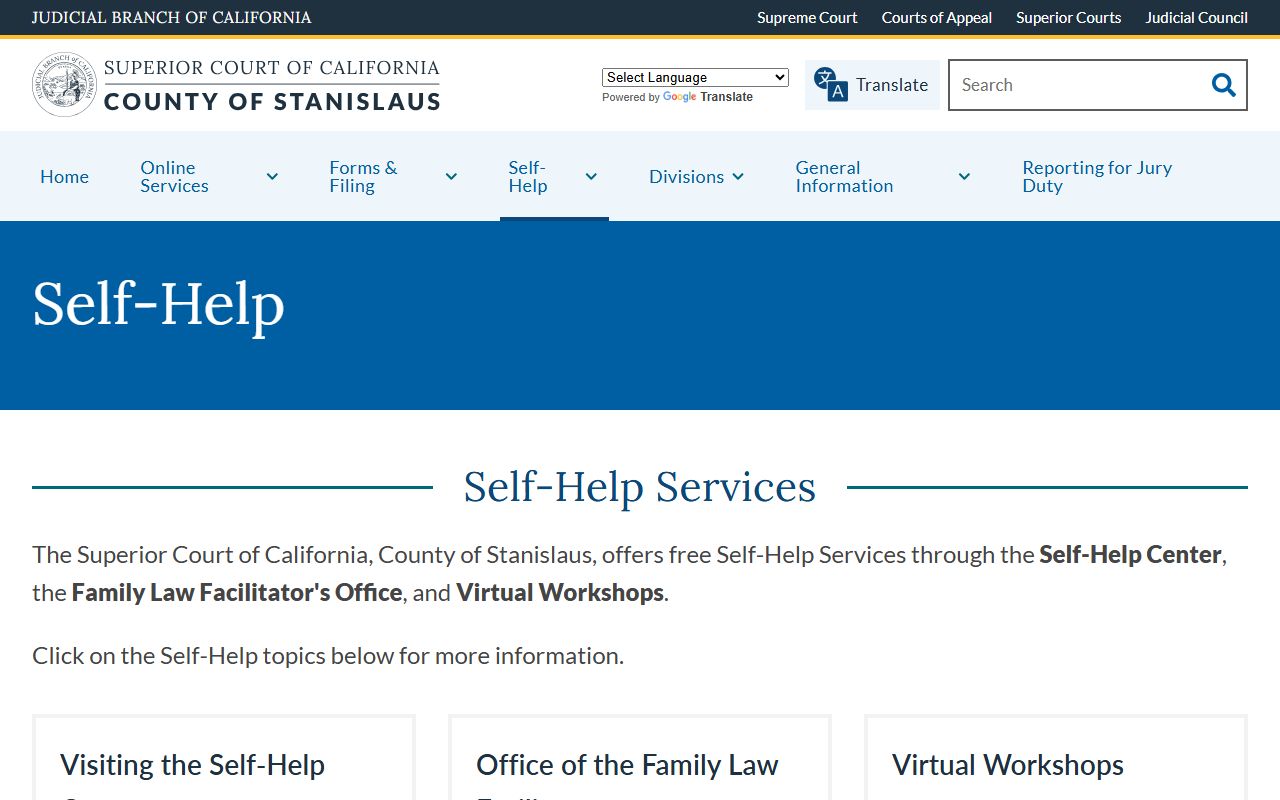
The court's self-help landing page points to the local center, the facilitator, and workshops.
The statewide self-help site adds guides and forms used across California.
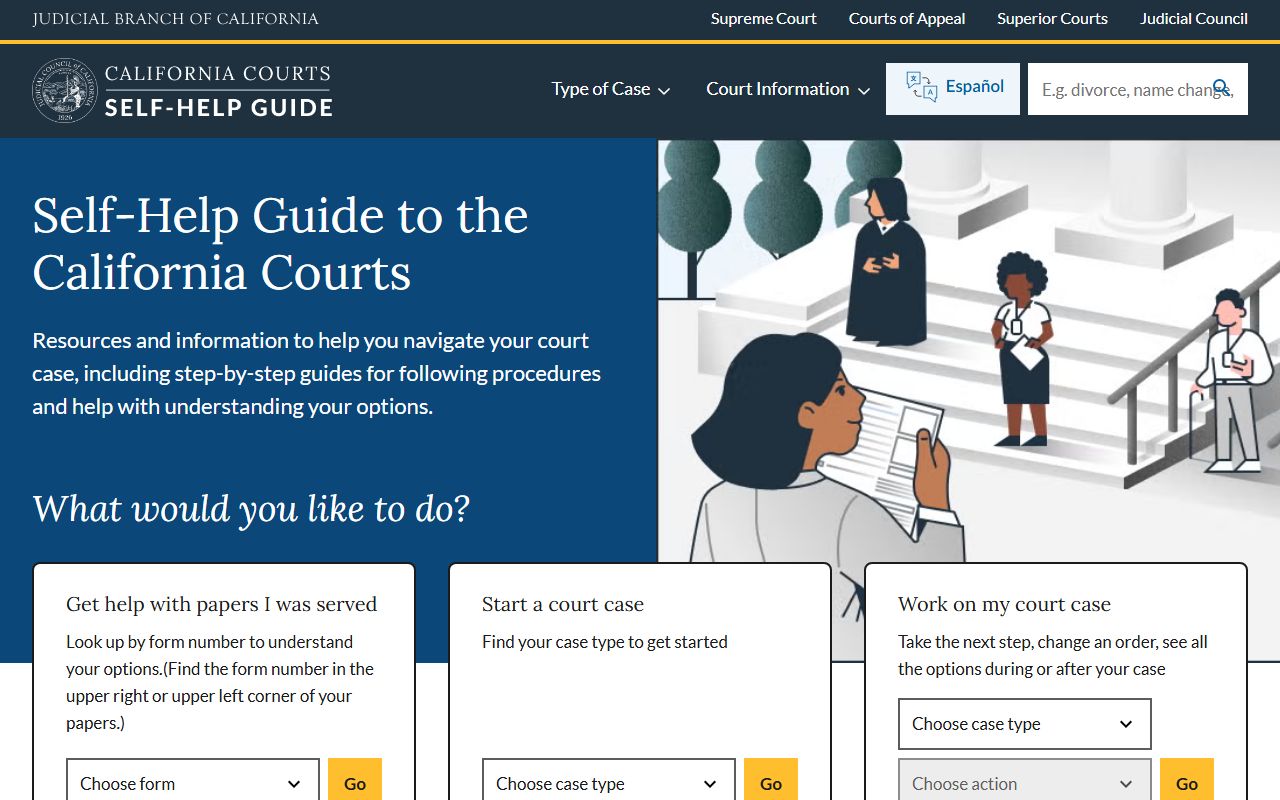
Together, the local center and the state site cover most procedural questions a self-represented person has. The Self-Help Center helps across many case types, including custody, support, divorce, restraining orders, guardianships, conservatorships, small claims, and expungements. It serves walk-in customers on a first-come basis and answers email within a couple of business days. For court forms, the statewide finder holds the Judicial Council forms every Superior Court uses, which keeps you from filing the wrong version.